Beyond the ceiling of function
On perspective shifts, design leadership, and what sits underneath visible outputs: What Future London Academy made possible — and why it still shows up in the work.

When people ask why I write about relevance, systems, futures thinking, and Brand Agentic OS — big part of the answer goes back to my time at Future London Academy.

Before that, I had already spent years in senior creative leadership roles, working across brand, design, and business challenges from the inside. I knew how to build, guide, and deliver.
But I had also hit the same ceiling more than once. At some point, it became clear to me that I was no longer looking for the next step within the function. I wanted a wider frame.
I wanted to understand how businesses really work: How decisions get made, how leadership shapes outcomes, and what actually drives long-term relevance.
That is what made Future London Academy and their Executive MBA for Design Leaders so compelling to me. What immediately stood out was that this was not framed as another design course, and not even as a traditional MBA in disguise.
The programme is built specifically for creative and design leaders with 15+ years of experience and combines a rigorous MBA-style curriculum with leadership coaching, mentorship, and a global network designed to stay with you long after the programme ends. It is delivered over nine weeks across one year in London and California, which means it is structured for people who are already operating at a senior level and want to apply what they learn in real time, not step out of practice to collect theory.


That mattered to me because I was not looking for more inspiration in the usual sense. I was looking for a broader operating view — one that connected finance, leadership, operations, growth, culture, and decision-making, and that treated business as a living system rather than as a set of isolated functions.
Future London Academy explicitly positions the programme as a business education experience for design leaders, one that goes beyond finance, operations, and business strategy alone and aims to prepare both leadership and business for the future. That wider frame was exactly the point.
It gives you a real 360-degree view of business, taught by top-tier practitioners from around the world. The opportunity to think with them, ask candid questions, and do that in a safe and welcoming setting is hard to overstate. That alone is priceless.
And the quality of that practitioner access is not marketing fluff. Future London Academy describes the faculty as CEOs, CFOs, COOs, investors, and business leaders from forward-thinking companies, and the published faculty list includes figures such as Michael Wolff, James Hilton, Rachel Kobetz, Margaret Ochieng, Kate Stanners, Tom Elvidge, Ajit Singh, and Adrian Talbot.
That mix matters because it exposes you to very different angles on how businesses actually operate: brand, finance, innovation, leadership, growth, culture, organisational behaviour, and investment logic.
You are not just hearing one perspective repeated back to you. You are seeing how the wider system works from multiple vantage points at once.
That was one of the most important parts for me.
At a certain stage in your career, the value is no longer just content. It is the calibre of the room. It is the chance to think alongside people who have built companies, led functions, scaled teams, priced businesses, advised founders, and navigated change at a level that forces you to widen your own frame.
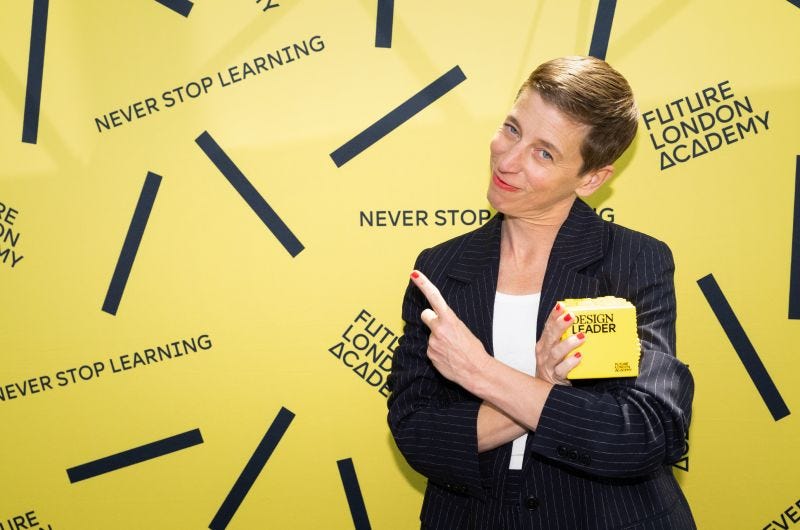
Future London Academy’s model is very consciously built around that: a curated cohort of around 30 global leaders, plus direct access to senior practitioners, mentors, and coaches. #neverstoplearning
That combination of business depth, seniority, and openness was rare — and it is probably what stayed with me most.
Looking back, the programme shaped more than I realised at the time. It helped me build a stronger strategic vocabulary and sharpened the systems and relevance thinking that now defines much of my work. It did not hand me a ready-made philosophy. What it did was shift my altitude.
I stopped looking at work mainly through the lens of function and started paying much closer attention to the wider operating logic underneath it: How organisations behave, how leadership decisions ripple outward, how coherence gets lost, how culture and structure interact, and how relevance is built — or eroded — over time.
A lot of what I am building today has roots in that shift. My writing around Longer→Now, my interest in systems and relevance, and the direction toward Agentic Brand OS all come from a deeper preoccupation with what sits underneath visible outputs. Not just what a company says, but how it behaves. Not just what a brand looks like, but how it stays coherent under pressure, across teams, over time, and increasingly across AI-mediated touchpoints. That way of thinking did not begin and end at Future London Academy, but the programme played a real role in making it legible to me.
The peer side matters too. Future London Academy positions the cohort and alumni network as a long-term part of the experience, not an afterthought, and that makes sense.
At senior level, growth is often accelerated not only by teaching, but by exposure to people who are asking adjacent questions at similar altitude. You see how others frame problems, where they place value, how they lead, what they are wrestling with, and how they translate ambition into action. That kind of network does not just validate you; it stretches you.
For me, that is why the programme mattered.
It was not simply a credential, and it was not just a moment of career development. It was one of the places where the next phase of my thinking started to take shape.
It helped me move beyond the boundaries of a role, beyond the ceiling of function, and closer to the work I care about now: strategy, systems, long-term relevance, and the question of how businesses and brands remain coherent in a world that is becoming more complex, more cultural, and more agentic.
That is also why this is not really just a story about choosing a programme. It is a story about a shift in perspective — and about how that shift still shows up in the work I do today.